Critical NGINX Heap Buffer Overflow Vulnerability CVE-2026-42533 Threatens Remote Code Execution on Millions of Servers Worldwide

F5, the parent company of the widely used NGINX web server software, has issued a critical security advisory regarding a high-severity heap buffer overflow vulnerability that could lead to remote code execution (RCE) or a sustained denial-of-service (DoS) attack. The flaw, tracked as CVE-2026-42533, resides within the NGINX script engine and affects over a decade of software releases, dating back to 2011. Security researchers warn that while F5 initially categorized the risk as primarily a denial-of-service issue, the nature of the vulnerability may allow sophisticated attackers to bypass modern memory protections and take full control of affected systems.
The vulnerability was officially addressed on July 15, 2024, with the release of NGINX 1.30.4 (stable) and 1.31.3 (mainline), as well as NGINX Plus 37.0.3.1. Administrators managing NGINX deployments are urged to prioritize these updates, as the software powers approximately one-third of all websites globally, including critical infrastructure for some of the world’s largest technology companies and financial institutions.
Technical Analysis of the Two-Pass Evaluation Flaw
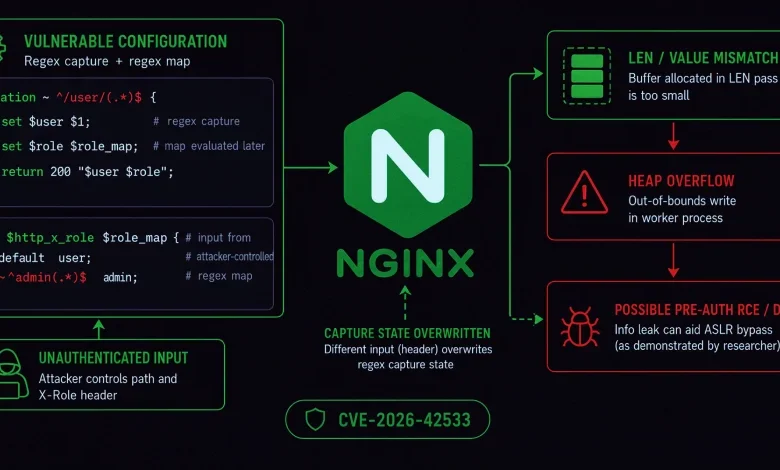
At the heart of CVE-2026-42533 is a fundamental design flaw in how the NGINX script engine handles string assembly from directives during the processing of HTTP requests. NGINX utilizes a "two-pass" evaluation system to optimize memory allocation and performance. In the first pass, the engine scans the required directives to calculate exactly how many bytes are needed for the final output string. Once this measurement is complete, it allocates a buffer on the heap of that specific size. In the second pass, the engine executes the directives again to write the actual data into the pre-allocated buffer.
The vulnerability manifests when a specific configuration pattern is used: a regular expression-based map directive whose output variable is referenced in a string expression following a capture from a previous regular expression match. Under these conditions, the two-pass system fails because both passes rely on a shared global state for regex captures.

During an attack, an adversary sends a specially crafted HTTP request. In the first pass, the engine measures the buffer based on the original capture (for example, a $1 variable from a location block). However, evaluating the map directive’s regex in between the first and second passes can overwrite the shared capture state. Consequently, during the second pass, the engine writes data based on a different, attacker-controlled capture length into a buffer that was sized for the original, smaller capture. This results in a heap buffer overflow where both the length of the overrun and the content of the data are dictated by the attacker’s request.
Severity Scores and Scope of Exposure
The security community has assigned a high level of urgency to this flaw. F5 has rated the vulnerability with a CVSS v4 score of 9.2 out of 10, indicating a critical severity level. Under the older CVSS v3.1 scale, the flaw receives an 8.1. The discrepancy between the two scores often reflects the updated v4 framework’s more nuanced approach to assessing the impact on various environments and the complexity of the exploit.
While the vulnerability is critical, it is not universal across all NGINX installations. Exposure is strictly dependent on the server’s configuration files. For a server to be vulnerable, it must utilize a configuration where a regex-based map variable is concatenated or used in a string expression alongside numbered captures (such as $1 or $2) from a preceding regex match.
Despite this configuration-specific requirement, the sheer longevity of the bug increases the potential attack surface. Every version of NGINX from 0.9.6 (released in 2011) through 1.31.2 is susceptible. This means that legacy systems that have not been updated in years are just as at risk as modern deployments running slightly older versions of the mainline branch.
The Debate Over Remote Code Execution and ASLR Bypasses
One of the primary points of contention regarding CVE-2026-42533 is the feasibility of remote code execution. In its official advisory, F5 noted that the flaw could allow RCE only in environments where Address Space Layout Randomization (ASLR) is disabled or can be otherwise bypassed. ASLR is a standard security feature in modern operating systems that randomizes the memory addresses used by system processes, making it difficult for an attacker to predict where to jump in memory to execute malicious code.

However, Stan Shaw, a prominent security researcher who discovered and reported the flaw under the handle "cyberstan," argues that the vulnerability is far more dangerous than F5’s advisory suggests. Shaw’s research indicates that the clobbering of the capture state works in both directions. When an attacker-controlled capture is smaller than the original measurement, the writing pass does not fill the entire buffer. This results in the server returning uninitialized heap data to the attacker.
Shaw demonstrated that on a default installation of Ubuntu 24.04, a single unauthenticated GET request could be used to leak memory addresses from the heap. These addresses provide the "map" an attacker needs to calculate the locations of critical functions, effectively bypassing ASLR. "A reader of the F5 advisory could reasonably conclude this is DoS-only on default systems. It is not," Shaw stated. He claims to have achieved a 100% success rate in triggering these conditions during his testing.
Chronology of NGINX Script Engine Vulnerabilities
The discovery of CVE-2026-42533 marks the third time in recent months that NGINX’s expression-evaluation code has been found to contain a heap buffer overflow. This "trilogy" of vulnerabilities highlights a recurring weakness in the architectural design of the NGINX script engine.
- CVE-2026-42945 (Rift): Disclosed in May 2024, this flaw involved a stale flag in the script engine that led to incorrect buffer sizing. It was quickly exploited in the wild following the release of public proof-of-concept code.
- CVE-2026-9256: Discovered shortly after Rift, this bug focused on overlapping captures within the rewrite module, again causing a discrepancy between the measurement and writing phases of the engine.
- CVE-2026-42533: The current vulnerability, involving the clobbering of shared capture states via the
mapdirective.
The common thread among all three vulnerabilities is the "two-pass" design. While efficient for performance, the design inherently trusts that the measurement taken in the first pass will remain valid during the second pass. These recent disclosures suggest that the internal state of the engine is more volatile than previously assumed, allowing various directives to interfere with one another and break the security assumptions of the memory allocator.
Affected Products and Ecosystem Impact
The impact of CVE-2026-42533 extends beyond the core NGINX Open Source and NGINX Plus servers. F5 has confirmed that several other products in the NGINX ecosystem are affected, including:

- NGINX Ingress Controller: A critical component for managing traffic in Kubernetes clusters.
- NGINX Gateway Fabric: Used for modern API gateway implementations.
- NGINX App Protect WAF: A web application firewall designed to protect against common web exploits.
- NGINX Instance Manager: A tool used to track and configure large fleets of NGINX instances.
At the time of this report, F5 had released patches for the core server and NGINX Plus, but specific fixed builds for the Ingress Controller and other downstream products were still being finalized. Organizations utilizing these tools are advised to monitor F5’s support portal for immediate updates.
Mitigation Strategies and Remediation
The most effective and recommended remediation is to upgrade to the latest versions of NGINX. For those who cannot immediately apply patches, F5 and independent researchers have suggested temporary mitigations.
The primary workaround involves modifying the server configuration to use "named captures" instead of "numbered captures." By using a syntax like (?<name>regex) instead of standard parentheses, the capture state is handled differently by the engine, which generally avoids the specific clobbering path identified in CVE-2026-42533.
However, Stan Shaw warned that this mitigation might not be exhaustive. He identified a secondary, narrower path where a map directive defining the same named group as a location regex could still trigger the overflow. This secondary path was confirmed using AddressSanitizer (ASan), a programming tool that detects memory corruption. Because of this, Shaw emphasizes that upgrading the software is the only way to ensure total protection.
To assist administrators in identifying vulnerable configurations, Shaw has released an open-source scanner on GitHub. This tool automates the process of checking NGINX configuration files, follows include statements, and flags instances where the exploitable ordering of map variables and regex captures occurs.

Future Outlook and Security Implications
As of late July 2024, CVE-2026-42533 has not yet appeared on the Cybersecurity and Infrastructure Security Agency (CISA) Known Exploited Vulnerabilities (KEV) catalog. However, security experts warn that the window of safety is closing. Stan Shaw has indicated that he intends to publish a full proof-of-concept (PoC) exploit 21 days after the initial patch release to allow administrators time to secure their systems.
The history of the "Rift" vulnerability (CVE-2026-42945) serves as a cautionary tale; once PoC code became public, active exploitation by threat actors began almost immediately. Given the ubiquity of NGINX and the high potential for RCE, it is highly likely that state-sponsored actors and cybercriminal groups are currently working to weaponize this latest flaw.
The discovery of three similar heap overflows in such a short period may prompt a broader re-evaluation of the NGINX codebase. While NGINX is celebrated for its speed and low resource footprint, the persistent issues within its script engine suggest that certain legacy components may require a fundamental rewrite to meet modern security standards. For now, the global cybersecurity community remains on high alert as the race between patch deployment and exploit development continues.